What Apple actually announced for M6 and M5 Ultra
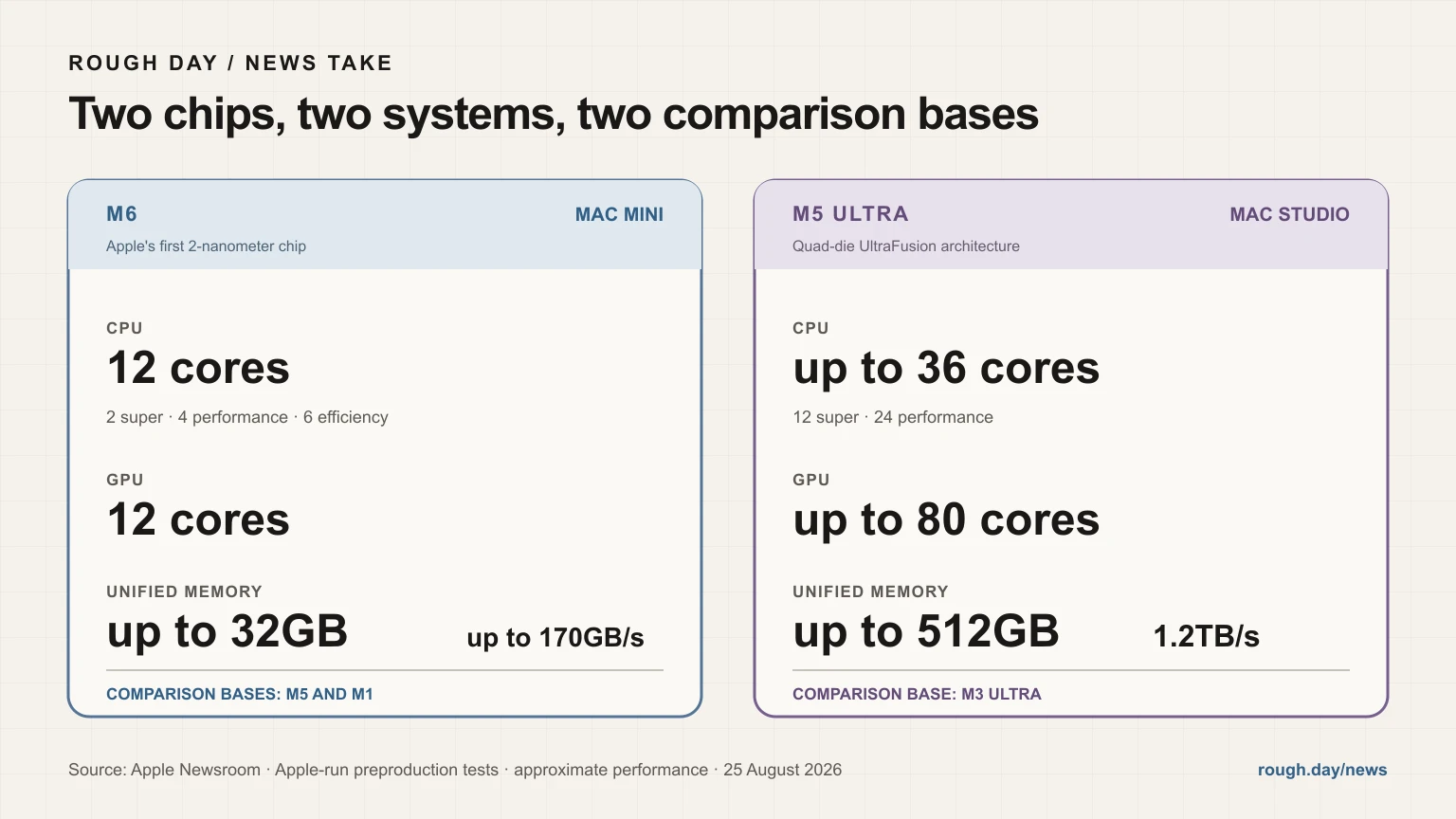
Apple's newsroom puts M6 in the new Mac mini and M5 Ultra in the new Mac Studio. The comparisons are to M5 and M1, and to M3 Ultra.
Apple published M6 and M5 Ultra on August 25, 2026. The newsroom page says Apple ran the tests that month on preproduction Mac mini and Mac Studio systems, using select industry-standard benchmarks, and that the figures reflect approximate performance.
Apple introduces M6 and M5 Ultra for a big leap in performance and AI compute is the Cupertino post. M6 debuts in the new Mac mini. M5 Ultra debuts in the new Mac Studio. Sri Santhanam, Apple's vice president of Silicon Engineering Group, called M5 Ultra “the most powerful M-series chip yet.”
What Apple stated for M6
M6 is Apple's first 2-nanometer chip. The page gives it a 12-core CPU with two more cores than M5: two super cores, four performance cores, and six efficiency cores. Apple says that complex has the world's fastest CPU core and the world's fastest single-threaded performance, up to 1.2x faster multithreaded performance than M5, and up to 2.4x faster than M1.
The GPU is a 12-core design, also two cores above M5, with a Neural Accelerator in each core. Apple cites a nearly 30 percent increase in peak GPU compute for AI versus M5, and more than 8x versus M1. Geometry rates rise 50 percent. The chip also lists updates to the shader core, Dynamic Caching, and hardware-accelerated ray tracing.
A Dual 16-core Neural Engine is new. Apple says it provides up to 2x the peak compute over previous generations, and that system frameworks can use both engines at once. Unified memory goes up to 32GB. Unified memory bandwidth goes up to 170GB/s, which the page calls a 10 percent increase over M5 and a 2.5x increase over M1.
The M6 comparisons in footnote 2 used a preproduction Mac mini with a 12-core CPU, 12-core GPU, and 32GB of memory; a 14-inch MacBook Pro with M5, a 10-core CPU, a 10-core GPU, and 32GB of memory; and a Mac mini with M1, an 8-core CPU, an 8-core GPU, and 16GB of memory.
What Apple stated for M5 Ultra
M5 Ultra uses UltraFusion to connect two dual-die M5 Max chips into a quad-die architecture, which the page calls a first for an M-series system on a chip. Inter-die bandwidth rises to over 4.4TB/s, and connection density rises by over 6x. Apple says the four dies behave as one unified processor.
The CPU is an up-to-36-core design: 12 super cores and 24 performance cores. Versus M3 Ultra, Apple cites up to 1.25x higher single-threaded performance and up to 1.3x higher multithreaded performance. The GPU is an up-to-80-core design with a Neural Accelerator in each core. Apple cites up to 4.5x the peak GPU compute for AI versus M3 Ultra, over 6x more than M1 Ultra, and up to 40 percent faster graphics than M3 Ultra. The GPU list includes a second-generation Dynamic Caching shader core, hardware-accelerated mesh shading, and third-generation ray tracing.
A 32-core Neural Engine is on the package. Unified memory goes up to 512GB. Unified memory bandwidth is 1.2TB/s, 50 percent higher than M3 Ultra. The page says that pool can hold huge datasets in local memory and run LLMs with hundreds of billions of parameters on device. The Media Engine lists dedicated H.264 and HEVC hardware, four ProRes encode and decode engines, and hardware-accelerated AV1 decode.
The Ultra comparisons in footnote 3 used a preproduction Mac Studio with M5 Ultra, a 36-core CPU, an 80-core GPU, and 256GB of memory; a Mac Studio with M3 Ultra, a 32-core CPU, an 80-core GPU, and 256GB of memory; and a Mac Studio with M1 Ultra, a 20-core CPU, a 64-core GPU, and 64GB of memory. The 512GB ceiling is not the memory size in that comparison.
Apple's developer frameworks and tools, including Core AI, Core ML, Metal, and Xcode, tap directly into both chips. The page says developers can run and fine-tune large AI models locally, and that the tools can use Apple Foundation Models, App Intents, or a developer's own models on device. Apple Intelligence features are in the Apple Beta Software Program and, the page says, will be available with macOS 27 this fall on a supported language.
What the page does not say
- That M6 succeeds the M4 generation. The newsroom comparisons for M6 are M5 and M1.
- Named competitive systems. Footnote 1 mentions shipping competitive systems and does not name them.
- Independent third-party measurements. Apple conducted the tests.
- A price, a ship date beyond “today,” or M6 outside the Mac mini.
- A tokens-per-second scoreboard, a vendor ranking, or a coding-agent row.
How this sits next to the archive
The August 25 rough.day Tech & AI edition already selected this newsroom story as the first item. The edition summary said the M6 succeeds the M4 generation. This take stays with the newsroom page. It does not replace that ranked item.
How it works explains the method. Rough Day considers reporting from the previous 24 hours, groups closely related coverage, and weighs consequence, independent confirmation, and timeliness. It publishes at most six stories per category. A news take is a source-linked argument. It is not a seventh archive slot.
The same edition also selected the SemiAnalysis Jalapeño report. What SemiAnalysis actually measured on OpenAI's Jalapeño keeps that lab visit and its measurement limit. This page keeps Apple's newsroom claims. The two takes share an edition date. They do not share a source or a scoreboard.
Sources
- Apple introduces M6 and M5 Ultra for a big leap in performance and AI computeApple, 2026. The August 25, 2026 newsroom post debuts M6 in Mac mini and M5 Ultra in Mac Studio, states the chip comparisons, and records Apple's preproduction benchmark footnotes.